Sunday, December 5, 2010
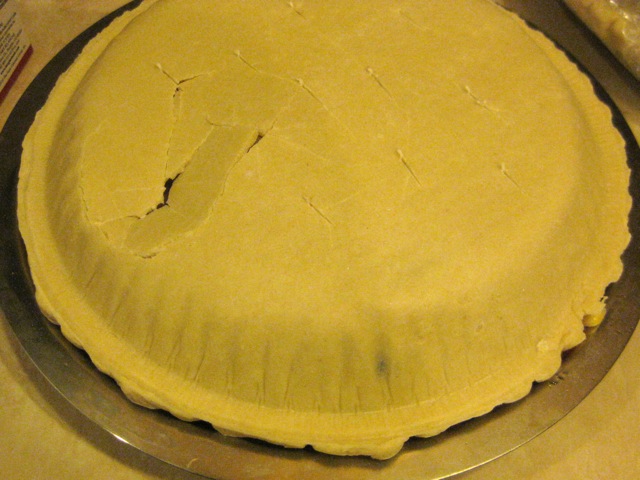
The Easiest Veggie Pot Pie
Saturday, May 15, 2010
Yum! Fries from the Oven

Sometimes I just need that crunch, but I don't need the fat. So here is how I make oven fries:
Preheat the oven to 450 degrees F. Peel as many potatoes as you feel like eating, but no more than can be spread on a cookie sheet in a single layer. Rinse and slice into french fry shapes or round slices, whatever you like. Spray a cookie sheet with spray oil mix, or line with parchment. Pile the sliced potatoes in the middle and sprinkle generously with a seasoning mixture of your choice. Mix it up with your hands and spread the slices in a single layer.
Place in oven and cook for 20-30 minutes, depending on how thick the slices are. Turn the slices after about 10 minutes and again after 20, or as needed. You'll know they are done when the edges are browned and the slices have puffed up a bit. Remove from oven and place in bowl or plate. Salt to taste and eat right away!
Saturday, July 25, 2009
Make a salad!

Mark Bittman, a non-vegan, offered 101 salads in a recent New York Times article. He started the list with the vegan salads. I copy them here for ease, and note that the original article can be found at the NYT website. I have removed what I consider gratuitous comments on non-vegan additions that Mark made. If you try some, let us know how you like them!
For fat-watchers (and yes, I'm one of them), I have starred those that call for no oil. Of course, many of the salads that call for a vinaigrette can be made with one that is fat-free.
MOSTLY VEGAN SALADS
1. Cube watermelon and combine with tomato chunks, basil and basic vinaigrette. You can substitute peach for the watermelon or the tomato (but not both, O.K.?).
2. Mix wedges of tomatoes and peaches, add slivers of red onion, a few red-pepper flakes and cilantro. Dress with olive oil and lime or lemon juice. Astonishing.
* 3. A nice cucumber salad: Slice cucumbers thin (if they’re fat and old, peel and seed them first), toss with red onions and salt, then let sit for 20 to 60 minutes. Rinse, dry, dress with cider vinegar mixed with Dijon mustard; no oil necessary.
4. Shave raw asparagus stalks with a vegetable peeler. Discard the tough first pass of the peeler — i.e., the peel — but do use the tips, whole. Dress with lemon vinaigrette and coarse salt.
5. Grate or very thinly slice Jerusalem artichokes; mix with pitted and chopped oil-cured olives, olive oil, lemon juice and a sprinkling of coarsely ground cumin. Unusual and wonderful.
6. Sichuan slaw: Toss bean sprouts, shredded carrots and celery, minced fresh chili, soy sauce, sesame oil and a bit of sugar. Top with chopped peanuts and chopped basil, mint and/or cilantro. (The full trio is best.)
7. Grate carrots, toast some sunflower seeds, and toss with blueberries, olive oil, lemon juice and plenty of black pepper. Sweet, sour, crunchy, soft.
* 8. Chop or slice radishes (or jicama, or the ever-surprising kohlrabi) and combine with chopped or sliced unripe (i.e., still crunchy) mango, lime juice and mint or cilantro.
* 9. Chop or slice jicama (or radishes or kohlrabi) and mango and mix with coconut milk, lime juice, curry powder and cilantro or mint.
10. Cook whole grape tomatoes in olive oil over high heat until they brown lightly, sprinkling with curry powder. Cool a bit, then toss with chopped arugula, loads of chopped mint and lime juice.
11. Chop and steam baby or grown-up bok choy until crisp-tender, then shock it in ice water. Drain, then toss with halved cherry tomatoes, capers, olive oil and lemon juice.
12. Combine sliced fennel and prune plums; serve with vinaigrette spiked with minced ginger. Nice pairing.
* 13. A red salad: Combine tomato wedges with halved strawberries, basil leaves, shaved vegan Parmesan and balsamic vinegar.
14. A classic Moroccan thing: Thinly slice carrots, or grate or shred them (the food processor makes quick work of this). Toss with toasted cumin seeds, olive oil, lemon juice and cilantro. Raisins are good in here, too. There is no better use of raw carrots.
15. Cut cherry or grape tomatoes in half; toss with soy sauce, a bit of dark sesame oil and basil or cilantro. I love this — the tomato juice-soy thing is incredible.
16. Slice fennel and crisp apple about the same thickness (your choice). Combine, then dress with mustardy vinaigrette and chopped parsley. Come fall, this will be even better.
17. With thanks to Szechuan Gourmet restaurant: Finely chop celery and mix with a roughly equal amount of pressed or smoked tofu, chopped. Dress with peanut oil warmed with chili flakes and Sichuan peppercorns, then mixed with soy sauce.
18. Roughly chop cooked or canned chickpeas (you can pulse them, carefully, in a food processor) and toss with olive oil, lemon juice, lots of chopped fresh parsley and mint, and a few chopped tomatoes. Call this chickpea tabbouleh.
19. Mix cooked cannellini or other white beans, chopped cherry or grape tomatoes and arugula or baby spinach. Lightly toast sliced garlic in olive oil with rosemary and red pepper flakes; cool slightly, add lemon zest or juice or both, then pour over beans.
20. Shred Napa cabbage and radishes. The dressing is roasted peanuts, lime juice, peanut or other oil, cilantro and fresh or dried chili, all whizzed in a blender. Deliciousness belies ease.
* 21. Dice cucumbers (if they’re fat and old, peel and seed them first) and toss with cubes of avocado, a little mirin, rice vinegar and soy sauce.
22. Thinly slice button mushrooms; toss with finely chopped carrots and celery and mix with mung bean sprouts. Finish with peanut or olive oil, sherry vinegar, a little soy sauce and minced ginger. (This is a super vinaigrette, by the way.)
* 23. Thinly slice some cucumbers (if they’re fat and old, peel and seed them first), red onions, radishes and fresh chili pepper. Soak for a few minutes in equal amounts vinegar and water, with some salt and sugar. When they taste lightly pickled, drain and serve, alone or over rice.
24. Blanch spinach, then drain and shock in ice water. Squeeze it dry, chop it and toss it with toasted pine nuts, raisins, olive oil and a tiny bit of balsamic vinegar. Capers are good, too. Quite elegant, actually.
* 25. Combine chopped bell peppers, tomatoes, red onion, chilies and cilantro, then toss with corn tortilla strips, toasted in a 350-degree oven until crisp (or yes, use packaged chips; why not?). Dust with chili powder and lots of lime juice.
26. Combine mushroom caps and thinly sliced red onions with olive oil; broil gently until tender and browned. Toss with a lot of chopped fresh parsley or basil (or both) and a simple vinaigrette. Some chopped escarole, arugula or watercress is good, too.
27. Cook whole, unpeeled eggplant in a dry, hot skillet or on a grill, turning occasionally, until completely collapsed and soft. Chop and toss with toasted pita, toasted pine nuts, cooked white beans and halved cherry tomatoes. Dress with olive oil, lemon juice and lots of black pepper. Or a vegan yogurt dressing is good, especially one laced with tahini.
28. Toss mâche or another soft green with toasted slivered almonds and roughly chopped fresh figs. Thin some almond butter with water and sherry vinegar to taste and use as a dressing.
29. Pit and halve cherries (or halve and pit cherries), then cook gently with olive oil and a little balsamic vinegar until they break down. Toss with chopped radicchio, endive, escarole or a combination, some toasted hazelnuts and more oil and vinegar, if necessary.
30. Fast, grown-up potato salad: Boil bite-size red potatoes. While still warm, dress them with olive oil, lemon juice, whole grain mustard, capers and parsley. Chopped shallots, bell peppers, etc., all welcome, too.
31. Roast beets whole (or buy them precooked), then slice or cube and toss with a little chopped garlic (or a lot of roasted garlic), toasted walnuts, orange juice and olive oil.
32. Same deal with the beets, but toss with cooked corn, arugula, olive oil, sherry vinegar and chopped shallots.
33. The real five-bean: Chickpeas, cannellini or other white beans, kidney or other red beans, steamed string beans and steamed yellow wax beans. Toss with vinaigrette, chopped scallions or red onion, and parsley.
34. Grill quartered romaine hearts, radicchio and/or endive. Drizzle with olive oil and sherry vinegar, and add dill and chopped shallots. Teeny-tiny croutons are great on this.
35. Combine cooked or canned black beans with shredded cabbage and this vinaigrette: olive oil, fresh orange juice, not much sherry vinegar, ground cumin.
36. Mix cooked or canned chickpeas with toasted coconut, shredded carrots, chopped celery, curry powder, olive oil, lime juice and cilantro.
----
Placing the vegan salads first gives them a role of importance in this article. A few years ago we would not have seen that.
Friday, July 24, 2009
Viva la soul! Review of Vegan Soul Kitchen
Bryant Terry's new cookbook, Vegan Soul Kitchen, takes "soul" seriously. Instead of focusing on traditional soul foods and simply replacing the animal products, Terry tries to define what the soul in soul food really represents. It's as much a book about a culture as it is about food. But that doesn't mean it is filled with dense gray pages of type. It also doesn't mean Terry is preaching or trying to convert anyone.
Why do I mention this book in this blog? Because many of these recipes are absurdly easy to make, and the others, while they may require a few pots and bowls and a little time, go together easily. Also because the cookbook includes directions for making several home-made condiments, which can enhance your convenience food!
Baked sweet potato fries
When I first opened this book I was confused. The book is not divided in the usual sections: appetizers, main dishes, side dishes, dessert, breads, blah blah blah. Instead it is divided into sections that are important to those southerners who swear by soul food. That means we get a whole chapter on watermelon. And drinks. And condiments. Along with the expected (but differently categorized) chapters on vegetable side dishes, grain dishes, protein dishes, desserts and other sweet things.
The whole of it adds up to a focus on the lighter parts of the meal. It's a great book for parties, right out of the box. It's also a good book for home-made staples. You can create a light corn broth, a zinging cajun-creole seasoning mix, pickles and ketchup and salsa and chutney and more. Terry is also interested in keeping his meals healthy, so you'll find little emphasis on fat and lots of emphasis on fresh.
cajun-creole spice mix
In other words, this book is more for the edges than the center. You will find red beans and rice and you will find "not-so-dirty rice" and hoppin' john, yes. There are many main dish recipes. But the bulk of the book is in the seasoning, the introduction, the end of the meal. Not to mention the melody.
Every recipe is prefaced by the name and performers of a piece of recorded music. The cookbook itself begins with the score for "Blessing" by Donald Bryant. After the song we are usually treated to a little bit about the food, where it's from, memories, some hint of how it came to be.
Some nuts and bolts:
* Every recipe starts on a new page, at the top.
* There is a section on equipment at the beginning.
* There are color photos sprinkled through it.
* Although some of the recipes take several steps, none require the skill of a kitchen magician. You can make these.
corn broth on its way to becoming succotash soup
I tested several recipes and enjoyed them all. When I made Succotash Soup with Garlicky Croutons I told my daughters that this one recipe was worth the price of the book. I am now using the cajun-creole spice mix that I created from the chapter on condiments, and I know I don't have to settle for anything commercial again.
straining the succotash soup. easier than I thought.
File under "entertainment", "basics", "staples", and "VEGAN".
crossposted at Vegan Soapbox
Sunday, June 7, 2009
PETA's Vegan College Cookbook
Check out PETA's Vegan College Cookbook
at peta2.com.
I just took a look at PETA's Vegan College Cookbook at the bookstore. I was surprised at how simple the recipes are. It's full of really convenient vegan recipes. They are super-easy.
And none of the recipes require a stove!
Thursday, April 30, 2009
Just add color

Sometimes we are not having a complicated meal. I admit to fixing myself some dishes, like the above, that are as simple as they come. In this case, it is especially important to consider the color of the dish itself. The right color can make the dish taste better! I promise!

Incidentally, these vegetables are on the "okay" list of an elimination diet. An "elimination diet" is one that includes only those foods that are not likely to cause an allergic or sensitivity reaction. I am currently on one of these diets for a week - or more, depending on results - to discover if certain foods might be the culprits in the inflammation I experience (arthritis).
Dr. McDougall has a clear explanation of when you might want to try this method to sort out a long-term health issue. Take a look at this newsletter.
Thursday, February 26, 2009
Cheap, Easy, Healthy
1 28 oz Can Whole Tomatoes (no salt added)
1 16 oz Bag Mixed Frozen Vegetables
4 oz Frozen Chopped Collard Greens
1/2 Large Bag Success Instant Brown Rice
This took about 10 minutes to make, only because the rice takes 10 minutes to make. I put the tomatoes and the veggies in a pot and as soon as the rice was done, i added it.
You can read about the nutrients here >>
Sunday, January 25, 2009
Simple satisfying dessert
I bought three quarts of organic strawberries there. When I got home I stole some oranges from a neighbor's tree. This tree grows untended and its fruits spill over the fence separating our lots, so it's fair! It's also true that I can get these fruits but my neighbors can't reach them without going into my yard.
I looked on the web for simple recipes featuring these two fruits, and came across the following on ChefMD:
Sweet Balsamic-Glazed Oranges and Berries
Preparation time: 10 minutes
Cooking time: 3 minutes
4 servings
194 calories per serving, 4% from fat
Ingredients
4 navel oranges
4 cups hulled strawberries, sliced
One-quarter cup balsamic vinegar
One-quarter cup packed light brown sugar
1 tablespoon juniper berries, crushed (optional)
One-quarter teaspoon nutmeg, preferably freshly grated
Pomegranate seeds (optional)
Preparation
Peel oranges and cut crosswise into one-quarter inch thick slices. Arrange on four serving plates. Arrange strawberries over the orange slices. In a small saucepan, combine vinegar, brown sugar, and, if desired, juniper berries. Bring to a boil over medium heat, stirring occasionally. Strain out juniper berries if using. Drizzle mixture over fruit; top with nutmeg. Garnish with pomegranate seeds, if desired.
Substitutions
If you can find them, use blood oranges—their flesh and juice are tomato-red, but orange-sweet.
Tips
The balsamic glaze thickens as it sits. If you use the juniper berries, be sure to strain them from the glaze before serving. Their aroma lasts just long enough to perfume the sauce, and deepen its flavor. These berries are too strong to eat by themselves. The optional pomegranate seeds provide crunch and visual delight. When they are in season in the fall and winter, make sure to buy a whole pomegranate, just for the wonder of those nuggets of tartness and crunch, and to make this dish exceptional.
Nutritional Analysis
Total fat (g): .9;Fat calories (kc):8.1;Cholesterol (mg):0;Saturated fat (g): .1;Polyunsaturated fat (g): .3;Monounsaturated fat (g): .1;Fiber (g):7.9;Carbohydrates (g): 48;Sugar (g): 40/;Protein (g): 2.7;Sodium (mg): 11;Calcium (mg):11;Magnesium (mg): 38;Zinc (mg):.3;Selenium (mcg):2;Potassium (mg):645;Flavonoids (mg):7.4;Lycopene (mg):0;Vitamin A (RE): 43;Beta-carotene (RE): 96;Vitamin C (mg): 184 Vitamin E (mg): 1.09;Thiamin B1 (mg):0. 19;Riboflavin B2 (mg): 0.17;Niacin B3 (mg): 0.9;Vitamin B6 (mg):0. 17;Folic acid (mcg):83
-------
The recipe is easy to make, delicious, and rather gourmet in effect. You can see the recipe on the website here:
http://www.chefmd.com/recipe_display.php?id=18
Also on this page is a video showing the doc-chef talking about the virtues of strawberries and making the dish. Excellent.
Friday, September 26, 2008
Sweet potato and cannellini bean hummus

For me, one of the harder parts of veganism is in the sandwich department. How often can we eat hummus (well, actually, maybe every day would be fine for me)? How can we add some variety that will also appeal to more skeptical (usually omnivorous) friends and family? I am finding more and more recipes for spreads that appeal on every level.
The other day I made this dip from sweet potato and canned white beans. The recipe is from Vive le Vegan, a nice vegan cookbook with a special section on food for babies (as well as larger sections on breakfast and baked goods than I usually find in vegan cookbooks).
It has a slightly sweet taste, is good as a dip or a spread. It is very easy to make with a blender or food processor. It is going into my list of spreads I will make again.
In case you want to run out and get the ingredients before you get the cookbook, it contains cannellini beans, cooked yam, lemon or lime juice, garlic, olive oil, hot sauce, salt, pepper, toasted pine nuts, fresh cilantro (optional garnish).
Saturday, July 5, 2008
Vegan Fire and Spice: Just What the Tastebuds Ordered
Robin Robertson’s new cookbook, Vegan Fire and Spice, is garnering rave reviews from all over. And with good reason. The dishes are easy to make, use commonly-available fresh ingredients, and offer a splendid array of tastes.
Many of us who have been vegetarian or vegan for a while reach a point when we want to do more than order Indian take-out. We want to make Indian take-out. Not to mention African, Caribbean, South American, and more. We want to shake up our own kitchens by bringing in different techniques and flavors. This book promises to give us the means. The book is a reworking of Robertson’s Some Like it Hot, with all recipes veganized and 25 additional recipes added. It is also the first to be published by Robertson’s new enterprise, Vegan Heritage Press. I recently tested several of the recipes from different parts of the book and all were successful. Some made it to a coveted place on my sure-to-make-again list because they are simply too good.
The cookbook is divided into sections, each section a geographical region that is known for spicy and hot dishes. When you open to that section there is a list of recipes, categorized by “appetizers”, “soups”, and so on. The recipes, then, are not listed in their entirety in one place. The index is complete, however, so if you are looking for a specific recipe and don’t remember where it comes from you will find it there. It makes sense to look within a region for a menu of dishes rather than take a chance on mixing cultures, picking one from Italy and another from China, for example. For this reason I find the arrangement agreeable.
Each recipe is on its own page. No sharing. I prefer this standard, as it’s easier to find the recipe and to follow it.
There are no pictures, other than on the cover. I love pictures but I appreciate the economies of leaving them out. It adds to the adventure, too.
The recipes are easy to make. I admit to being an occasionally ambitious cook, happy at times to create complex dishes that take specialized skills. Most of the time, though, I prefer to put together meals quickly and easily and know they will turn out right even when some parts go wrong or I have to substitute some ingredients. Forgivable recipes, I call them, that’s what I look for.
From my experiments with Fire and Spice, I believe that’s what we have here: forgivable recipes. When I made the Senegalese soup (p. 119) the first time I got distracted and burned the mix of onions and celery. I didn’t want to start over so I scraped out the less-burned parts and dumped them in another pan and continued on. I suspect the soup would have been better if I’d had the full contingent of onion and celery and none of it was burned but it was nonetheless delicious. When I made the vegetable pakoras I didn’t chop the cauliflower enough, and I made the mistake of throwing in the cauliflower before I had the flour and water mixed. But I soldiered on and although the pakoras were not beautiful they were tasty indeed. Way too tasty, considering I made a full batch and there was only the one of me in the house.
Some of the mistakes I made came about because the recipes are not always as specific as they could be. One recipe calls for two Granny Smith Apples, another for a head of cauliflower, another for one or two yams or sweet potatoes. Not all of these recipes specify the size of these vegetables or an alternative measure, like weight or number of cups. In my experience some vegetables and fruits can vary dramatically in size. Sometimes the directions lack a little: the pakora recipe says to mix enough water into the flour mix to “make a batter”. But how thick?
And sometimes the timing is off. When I made the Chickpea and Green Bean Curry (p. 158) I had to make my dinner guest wait because it took much longer for the green beans to cook than estimated. My beans were fresh and cut according to directions and I think they were typical of what you would find in a grocery vegetable section, so I’d suspect my experience would be typical. Most of the time I did find the time estimates within the recipes to be accurate, however. What I would have appreciated, though, would have been estimates of time to make the entire dish.
Minor gripes. Most of the recipes do list ingredients by weight or cups and most of the directions are clear and unmistakable in intent.
The recipes call for fresh vegetables and fruits most of the time. Occasionally they require canned diced tomatoes or canned beans, but most of the ingredients are fresh, as they would be in their native countries. This means you do need to do a little preparation. The good news is that most of this preparation can be done ahead of time, as it would be in a restaurant if you were the sous chef (according to Wikipedia the more correct term may be commis chef, one who prepares vegetables unaided). The better news is that this is basic prep, nothing fancy, nothing beyond you.
Should you be new to kitchen equipment or preparation, though, there is a helpful section at the beginning of the book that tells you all you will need to know. There is also a section on the nature of spices, chiles, and other “exotic” ingredients. I inserted the quotation marks because seitan is about as exotic as they get here, meaning you should be able to find most of the ingredients, or reasonable substitutions, in any well-stocked grocery store, and the few remaining can be obtained at a natural foods store or even online.
Using fresh ingredients means the dishes will taste as good as they should. It’s worth using the freshest you can find because you’ll notice the difference.
Even though I see this book as the guide to an adventure the seasoned vegan is going to want to take, a brand new vegan cook can confidently prepare these delicious dishes and be proud.
Thursday, June 19, 2008
On equipping the kitchen
With What do I Cook?
An overview of cooking equipment
Although many of us like trying many different types of foods to find new tastes and uses for plant-based foods, when we cook such foods ourselves we rarely need any kind of specialized equipment. The basic vegan kitchen is really a simple kitchen.
The Basics
The basics will get you through most recipes. You can chop vegetables with a knife and cutting board, saute in frying pans, boil water and make soup or cereal in the large or small saucepan, mix simple cookies or salads or casserole mixtures in the large bowl.
Knives:
It's possible to get by with one knife, a chef's knife, but we believe in three types:
Chef's knife
Bread knife (serrated blade)
Paring knife
It's helpful at times to have more than one paring knife, possibly different sizes, but one will do. You'll want a knife sharpener as well. Whatever is recommended for the type knives you purchase. It isn't necessary to get the very best knives, as lovely as they are. A decent medium-quality brand should give you many years of good service.
If you are serious about cooking, learn how to use that chef's knife to its full advantage. When you have the skills, throwing together many fresh ingredients won't throw you.
Pans:
Frying pans: cast iron is great for adding iron to your diet and for cooking foods that require high heat, and to boot these pans are not expensive. It's nice to have the chef's pans, the expensive ones, but really you can do very nicely with a set of two or three reasonably-priced pans, whether cast-iron or stainless steel or some other material. You'll probably want to avoid aluminum and teflon because of their potential effects on your health.
Sauce pans: Another set of three, varying sizes. Good to have a set with heavy bottoms, again not aluminum or teflon. With lids.
Baking pans: Useful to have a cookie sheet or two. Cookie sheets can be used for components of many main dishes as well as for cookies.
Bowls and cups:
Two mixing bowls, one large and one small, should do you.
1 liquid measuring cup
1 dry measuring cup set
Utensils:
Pancake turner (aka spatula; depends on what country you're in)
Large mixing spoon
A set or two of measuring spoons
Cutting boards:
It's handy to have more than one. Wood is safer than plastic (bacteria survive on plastic longer than on wood).
Beyond the basics: making it easier:
If you find you have a real yen for this cooking thing, so much so that you want to branch out into sauces and smoothies and dips and many many chopped things and even some fancy baked stuff, you'll find that this equipment makes it easy and so much fun:
Blenders.
Regular blender. Find a good one. Don't just get the one on sale. Check the resources page at the end of this book for websites that offer unbiased reviews of kitchen equipment.
High-performance blender. A Vita-mix or equivalent high-performance blender can do things ordinary blenders can't, like make almond butter and whole fruit juices.
Immersion blender. Great for pea soup and similar mixtures. Just stick in the pot at an angle and whir away. Easier than processing batches of hot liquid in a regular blender.
Food processor. Again, don't go for the cheapest. You should be able to find a decent medium-size processor for not much more than the cheaper models and the first time you chop vegetables you'll be happy you did. Check reviews. Don't be fooled by advertising and don't compare on the basis of options. If you think you'd like to make bread with your food processor, you'll need to step up to a higher-quality one.
Plastic chopper. There are many of these out there, the small choppers with handles you turn. They are inexpensive, can replace a food processor for many foods (like onions), and usually are easy to clean.
Rice cooker. Rice cookers are simple beasts that do a great job on all kinds of rice. You can cook a whole pot full or less, and freeze what's left over in portion-size baggies.
Miscellaneous appliances. Grillers are great for grilled vegetables and sandwiches. Waffle irons make terrific vegan waffles. A stand mixer makes many mixing chores much easier and if it is heavy-duty enough it can make bread dough too. Crock pots continue to give us a way to get a meal started that can cook itself while we are away; especially handy for chile, soup, stew.
For most home cooks, a minimum of equipment is necessary to create a wide variety of delicious vegan meals. We recommend starting with the basics and adding as needed, as your interest expands. It can be a lot of fun to try dozens of recipes from the many excellent vegan cookbooks out there.
Monday, June 16, 2008
Easy roasted vegetables
One type of convenient product I have come to love is the spice or herb blend. I have a "greek seasoning" blend and a "creole seasoning" blend that can be used on almost anything. One example is this easy roasted veggie dish. These are general directions because the dish will vary with what you have on hand, what you like, how much you want to make.
Use fresh vegetables from your refrigerator. Or you could use the stew-type frozen vegetable mixes available in grocery markets for an even easier version. Root vegetables, like potatoes and turnips and onions, make fine roasting fodder. Bell peppers of any color, leeks, squash, all are good. The cruciferous vegetables, like cabbage and broccoli, may not fare as well but could work if the dish is covered long enough to get them steamed. Corn could make a great addition (frozen or fresh).
Estimate how many veggies you'll need based on how many will be eating and how big a pan you'll be using. You'll want the veggies to make a layer that is not too thick so they will all cook evenly. Wash and cut the vegetables into bite-size chunks. Leave skins on potatoes.
Pile the vegetables into a shallow roasting dish or casserole. Sprinkle a couple of tablespoons (or more, depending on how many there are, you want a very light coating) of olive oil on top, and a generous amount of greek seasoning mix on top of that (or try another seasoning mix that goes well with vegetables, like Italian). Mix lightly and cover the pan (with a lid or with foil). Bake at 350 degrees for 30-45 minutes, stirring two or three times. Remove lid or foil and let cook 5 - 10 minutes uncovered.
Wednesday, May 7, 2008
Convenient Vegan Cookbooks

It can be difficult being vegan. Especially when you're a new vegan and you don't know all the "ins and outs" of vegan shopping and cooking. Sometimes you can feel like being vegan is so hard that you might just think about dropping your new vegan habit.
STOP.
Please don't give up on veganism. Giving up on being vegan is giving up on yourself. You're not giving yourself enough credit. You CAN do this! You can!
Here is a list of some cookbooks that can help. These books make vegan cooking simple, easy, convenient, and cheap:
Specifically about vegan convenience and ease:
- Conveniently Vegan
- Easy Vegan Cooking
- The Everyday Vegan
- Skinny Bitch in the Kitch
- The Vegan Family Cookbook
- The Simple Little Vegan Slow Cooker
- Simply Vegan: Quick Vegetarian Meals
- Fresh and Fast Vegan Pleasures
- Vegan Microwave Cookbook
- Raw In Ten Minutes
- Vegan Express
Specifically for single vegans:
- Raw Food Made Easy For 1 or 2 People
- Vegan Bites: Recipes for Singles
- Vegan Meals for One or Two
- The Single Vegan
And here are some great beginner books for the newly vegan:
Sunday, April 6, 2008
Quick and Easy

Need something really quick and really easy? Think frozen foods.
Here is a snack or side dish:
Just take some frozen veggies, any package will do, and empty it into a ceramic or glass dish. Add some water, about half a cup, cover with plastic wrap, and microwave it for about 3-5 minutes. Then drain the veggies and put them on a plate or in a bowl. Season them with Mrs. Dash, Tony Chachere's, or your favorite spice blend.
Now eat.
I didn't say it was going to be the best meal of your life. But it's quick, easy, and relatively healthy :)
Sunday, February 17, 2008
A Childhood Favorite Soup
It's comfort food. So it's natural that there would come a time when I would want to bring that memory alive again, without the real chicken, excess salt, or pitiful broth. And so I put together this vegan version.
I had some "veat" left over from the "chicken" salad I made recently, reported here. I sliced that up while I heated some vegetable broth. In this case I used vegetable broth cubes in boiling water because that's what I had. To the boiling broth I added the veat "breast" slices, some chopped red pepper, and frozen peas. When it started to boil again I tossed in a chunk of cappellini that I had broken into pieces. In a few minutes it was done, ready for salt, pepper, and cayenne pepper. Honest. It's a lot better than Lipton's.
Saturday, February 2, 2008
Ordering in again
1. There are a total of six restaurants so far. One of the restaurants does not yet offer online ordering; you have to order by phone or email. I decided against that option simply because I want to stick with getting it all done online.
2. You have to complete an order at one restaurant before going to another. They are separate orders.
3. Delivery information is incomplete and seems to vary from restaurant to restaurant but I may have that wrong. To be safe, I ordered from a restaurant in Venice, California because it's relatively close to me (about 200 miles). And imagine my surprise when no shipping charge was made at all! But then I got a call from Jody at buykind saying they calculate shipping after the order is placed, and they offer a flat rate per box which is quite reasonable for me. She said I could add up to five more items for the same rate, so I am going back to choose a few more items.
4. The website could use some work. As a web designer myself I tend to be sympathetic. It can be hellish getting it the way you want. Also, this is a brand new business.
5. Because I ordered Saturday the order will be prepared and shipped on Monday and will arrive Tuesday. Sounds good to me.
Sunday, January 27, 2008
cabbage and potato soup
I like to make soups from what I have on hand. This one is substantial, earthy, inexpensive and I think delicious. It also freezes well. It isn't a quick meal but it's easy to put together if you are okay with chopping vegetables, and if you freeze portions they will be ready when you are.
Cabbage and potato soup
Makes about 8 servings (adjust to your needs; nothing is sacred!)
2 Tablespoons +/- oil
2 large potatoes
1 large onion
1 large carrot
1 clove garlic
1/2 head cabbage
1 - 2 quarts vegetable broth or water
1 - 2 tsp ground red pepper
paprika, black pepper, salt to taste
Peel potatoes and carrot. Chop onion. Heat oil in large soup pot, add onion. Cook, stirring occasionally, until onion is a bit soft. Chop garlic clove and add to pot, stir. Chop carrot, add to pot. Chop cabbage and stir into pot, cook a bit, then add broth or water. Cook until potatoes and cabbage are soft, about 20 minutes. Season with red pepper. Serve sprinkled with paprika and pepper and pass the salt.
Monday, January 21, 2008
Quick meals from books

There are different ways to get food on the table quickly and easily. One way is to use convenience food, one focus of this blog. A good cookbook for this approach is Conveniently Vegan (see link at right). This book offers many meals that require only a few easily-found ingredients, many of which can be from the cupboard or freezer.
Another approach, also frequently used in this blog, is to put together fresh ingredients or foods that you have made yourself previously when you had a few minutes. A cookbook that uses this approach is 20 Minutes to Dinner (see also the link on the right, just added today). This book is aimed more at people who like to cook, at least some of the time. It offers directions to cook or prepare many "components" of dishes, like dried beans or "breast of tofu" or vegetarian "sausage", so that you have, in essence, your own "convenience foods". Throughout the book are some lovely alternatives to everyday items that you can usually throw together very quickly, too - like the banana milk I made today to put on my cereal (banana, cold water, vanilla and a blender). Obviously, the advantage to making your own is that you know exactly what is in it. These foods may also save money.
20 Minutes also offers a food prep and nutrition chapter, with information on what equipment you need (very little) and on getting the most nutritional bang for the buck.
Some folks have posted complaints on amazon.com that it often takes longer than 20 minutes to get dinner on the table, using this book. From what I have sampled and read, I'd say this is probably true. However, the more skilled you are with your equipment the sooner you will get that meal out there. It's probably a good idea to assume it will take a half-hour most of the time, and sometimes you'll be pleasantly surprised.
Saturday, January 12, 2008
Order it online! Whereever you are in the U.S.
I have just ordered one week's worth from them. I will write about my experience here. I am hoping for the best - what could be more convenient than delicious vegan meals that are sitting in your refrigerator, ready to heat?
Tuesday, November 13, 2007
Veggie Bake
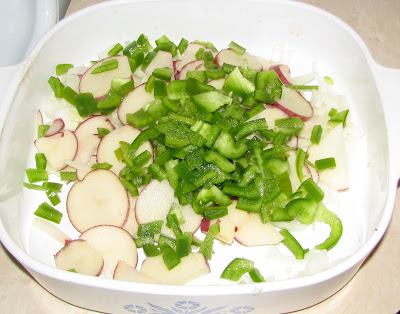
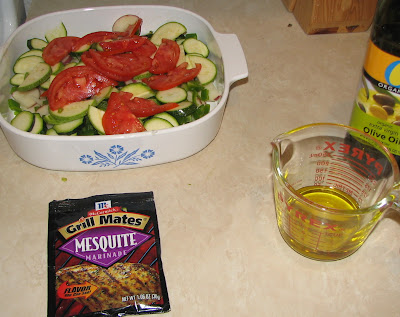
Those marinade mixes can be used to make a flavorful baked dish. Choose compatible fresh veggies. Here I grabbed red potatoes, summer squash, onion, bell pepper, and a tomato. Later I added some olive oil. Here's how I put it together:
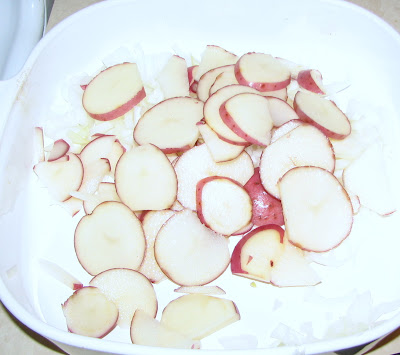
Slice the onions, throw them in a casserole that allows them to spread out a bit. Slice up the potatoes and add them to the pile.
Cut up the squash and bell pepper, toss on top,
then slice the tomato and layer it last.
Mix about a quarter-cup of olive oil (or less) with the marinade mix. Pour it over all. Stir a bit to mix.
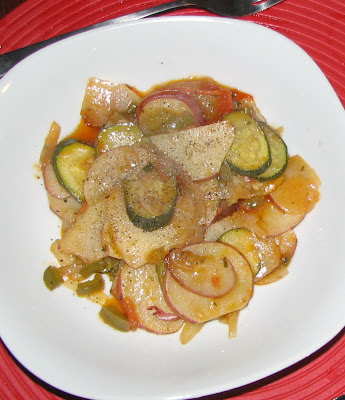
Cover the casserole and place in a 400 degree oven for 30-45 minutes, opening to stir two or three times. When it appears that the veggies are pretty much done, take the cover off and let the mixture steam off some of the liquid.
Serve on plates - two to four - and sprinkle with salt and pepper to taste.
Notes: I found the marinade a bit spicy. You may want to use less of it or more veggies. I also believe the mixture would do well with less oil, maybe 1/8 cup. If you don't have fresh veggies or are in more of a hurry, this dish would work with frozen vegetable mixtures quite well. Dump in one of those bags of potato mixtures, add the marinade-oil mix, throw in the oven.